

The military program of the Jewish state is shrouded in an ocean of rumors, secrets, and insinuations. On March 21, Iran launched a missile attack against the city of Dimona in southern Israel, as reported by The Times of Israel. The city of Arad also came under missile fire. In Dimona, at least 59 people were injured by direct hits. In Arad, a direct strike from a ballistic missile between buildings injured at least 115 people, nine of whom are in serious condition. According to Iranian state agencies, the attacks targeted the Israeli nuclear center, located 13 kilometers from Dimona and 30 kilometers from Arad, in retaliation for an attack on an Iranian uranium enrichment center in Natanz the previous day.
Inside the secrets of Dimona
"The Shimon Peres Nuclear Research Center in the Negev Desert—commonly known as the 'Dimona reactor'—has been considered for decades the place where Israel maintains its unofficial nuclear arsenal. Officially, the site is intended only for research purposes, but for about sixty years, it has been an open secret that this is where Israel created the nuclear bomb. In essence, this makes it the only nuclear power in the region," reports the BBC. Israel's nuclear program dates back to the mid-1950s when the first Prime Minister, David Ben-Gurion, envisioned a "nuclear safety net" to offset the military advantage of neighboring Arab states.
American-Israeli historian Avner Cohen writes in his book Israel and the Bomb: "Ben-Gurion's determination to start the nuclear program was a result of strategic intuition and obsessive fears, not a well-thought-out plan. He believed that Israel needed nuclear weapons as insurance if it could no longer compete with the Arabs in the arms race, and as a weapon of last resort in case of crisis." Ben-Gurion appointed Shimon Peres—later Prime Minister—as head of the Israeli nuclear program. Under Peres's guidance, Israel purchased a research nuclear reactor and plutonium separation technology from France in 1957, and in 1959, it acquired 20 tons of heavy water from Norway. Construction of the Negev Nuclear Research Center began in 1958 near Dimona.
Israel's campaign of misinformation
Although the site was initially intended for the development of nuclear weapons, the US only realized its true role a decade later, despite having information about its construction as early as 1958. This was largely due to Israel's successful campaign of misinformation and concealment. American journalist Seymour Hersh describes the plan to mislead the Americans in his book The Samson Option: "At Dimona, a fake control room had been built with computers that appeared to measure the thermal power of a 24MW reactor, as Israel claimed. Extensive exercises were held in the fake room so that technicians could avoid mistakes during visits by Americans. The goal was to convince inspectors that there was no nuclear material processing plant."
The American inspection of the site was largely formal. Cohen points out that the mission of the American scientists "was not intended to challenge the claims, but to check them. As a result, they did not know or did not want to examine the possibility that an underground plutonium processing plant existed right under their feet."
Plutonium production
In December 2024, the US National Security Archives released documents regarding the Israeli nuclear program. These show that Washington had been aware since the 1960s of the capability for plutonium production at Dimona. A December 1960 document from the US Atomic Energy Commission was the first and only official account confirming the existence of a plutonium processing plant at Dimona.
The secret agreement
In the 1960s, the US and Israel reached a secret agreement recognizing Israel's status as an undeclared nuclear power. By 1967, intelligence indicated that the reactor had reached full power, allowing for the production of nuclear weapons within 6-8 weeks. According to the Federation of American Scientists, the exact date of completion of the first active nuclear weapon remains uncertain, although it is estimated that Israel could have assembled its first primitive nukes in 1967 before the Six-Day War.
Prime Minister Golda Meir (1969-1974) adopted a policy of "nuclear ambiguity," stating: "First, we do not have nuclear weapons, and second, if necessary, we will use them." In 1986, Mordechai Vanunu revealed the secret arsenal. Working as a technician at "Machon 2," he took a camera and captured over 60 photographs, revealing that Israel ranked sixth in the world for nuclear arms.
Current forces
Today, according to SIPRI, Israeli nuclear forces include:
-
Air Force: Approximately 30 free-fall bombs, carried by F-15, F-16, and F-35 aircraft.
-
Ground-based missiles: Up to 50 Jericho warheads, with improvements in Jericho II and III.
-
Sea-based missiles: 5 Dolphin-class submarines, likely equipped with 10 Popeye missiles.
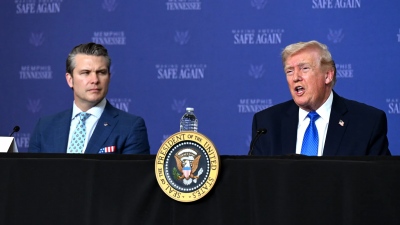
Regarding the threat of using nuclear weapons against Iran, Donald Trump, in a White House press conference, stated: "Israel won't do it, they will never do it," indicating that he would not allow "hot-headed Israelis" to use nuclear weapons.
www.bankingnews.gr


Σχόλια αναγνωστών